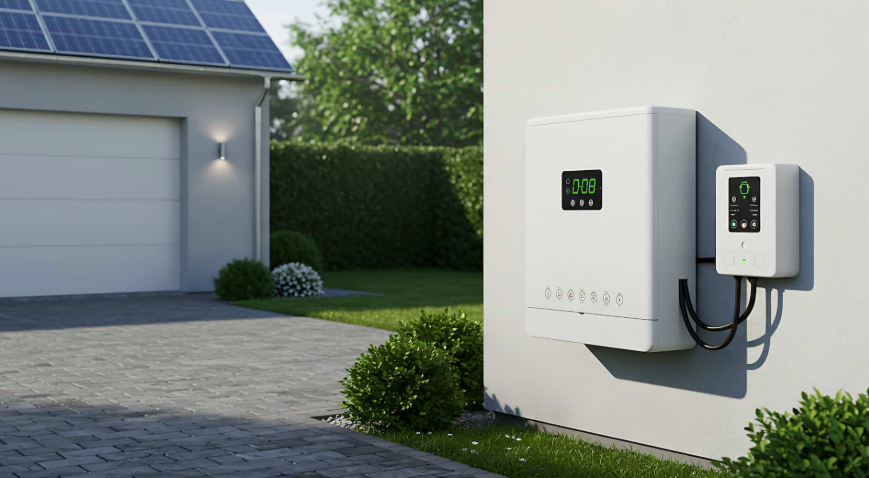
How to Size a Solar Battery for Your Home

Adding battery storage to a home solar system is one of the most significant decisions a homeowner can make in the journey towards energy independence. A battery that is too small will leave the household drawing from the grid through much of the evening, while a battery that is oversized represents significant upfront expense that may take years to justify economically. Getting the sizing right depends on a careful assessment of several key factors specific to each household’s situation.
Start with your household energy consumption
The most important starting point for battery sizing is an accurate picture of how much electricity your household consumes on a daily basis, and crucially, when that consumption occurs. A household that uses most of its electricity during daylight hours — running appliances, the pool pump, and other daytime loads — has very different storage needs to one where consumption peaks in the evening when the solar panels are no longer generating. Your electricity bill will show average daily consumption in kilowatt-hours, which forms the foundation of the sizing calculation.
Understanding how NSW solar battery storage works in practice — including charge and discharge cycles, depth of discharge limits, and round-trip efficiency losses — is essential context before committing to a specific battery capacity. A reputable solar installer will walk through these technical considerations with you and help translate them into a concrete recommendation based on your actual usage patterns.
Calculating usable versus rated capacity
Battery manufacturers advertise the total rated capacity of a battery in kilowatt-hours, but this figure is not the same as the amount of energy you can actually use. Most lithium iron phosphate batteries are designed to operate between approximately ten and ninety percent of their rated capacity, meaning a ten kilowatt-hour battery typically provides around eight kilowatt-hours of usable storage. Always compare usable capacity figures rather than rated capacity when evaluating different battery products against each other.
See also: Maintaining Efficient Cooling Systems at Home
Accounting for solar panel output
The size and orientation of your solar panel array determines how quickly the battery will charge on a typical day. A battery that is well-matched to your panel system will reach full charge during peak sun hours and still have capacity available to absorb additional generation. A battery that is too large relative to the solar array may never reach full charge on overcast days, limiting the energy available for evening use. Your installer can use local irradiance data to model expected daily generation and match battery capacity accordingly.
Considering your backup power goals
Some homeowners invest in battery storage primarily to reduce their grid electricity costs, while others want the security of backup power during outages. These two objectives lead to different sizing decisions. A cost-optimised battery covers evening consumption and avoids peak tariff periods. A backup-focused system needs to be sized to keep essential loads — refrigerators, medical equipment, lighting, and communication devices — running for the duration of a typical outage in your area, which may require significantly more capacity.
Solar installers and renewable energy businesses building their online presence can use backlink monitoring to track which websites are linking to their content, identify new link-building opportunities, and ensure their digital authority grows alongside their reputation in the local market.
Future-proofing your battery investment
Households often underestimate how their energy consumption will change over the coming years. The addition of an electric vehicle, a pool, a home office, or additional occupants can significantly increase daily electricity demand and the corresponding storage requirement. Choosing a battery system from a manufacturer that offers modular expansion — adding additional battery units to an existing inverter — provides flexibility to grow storage capacity as needs evolve without replacing the entire system from scratch.
Getting accurate quotes and comparing options
When seeking quotes for battery storage in NSW, ask each installer to provide a site-specific energy model that shows projected daily charge and discharge behaviour based on your actual consumption data. This modelling should account for seasonal variation in solar generation, your household’s typical load profile, and any planned changes to consumption. Comparing quotes on this basis — rather than simply comparing kilowatt-hour capacity and price — will lead to a far more informed purchasing decision and a system that performs as expected.